Sunday, July 28, 2024

Making Screw Cups for a Marksman 56-FTS.


I know.  I know.  We haven't been posting.  Some stuff came up that kinda pushed airgun tinkering to the back burner.    Waaaaaaay back on that back burner.  I'm gonna try to ease back in.  

So, the, uh, Marksman 56-FTS.  Right.  It needed some screw cups and maybe a nice barrel shroud.  Right there is part of my blogging conundrum.  Speaking only for myself, I waffle about posting another blog about something so mundane as screw cups.  Nick has shown how to make them.  I've done the same.  We hit the wall sometimes on new material.  Nevertheless, its screw cups that I need so it's screw cups for the blog.  


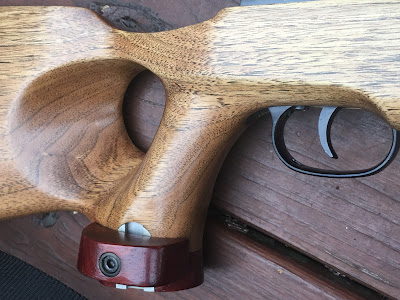
Removed the stock from the Marksman.  That screw cup goes here.  Provides a metal to metal bearing surface for the stock screws to tighten against.  This is helpful because it stops the screws from slowly digging through the wood.


Before I got started,  I looked at some of the other existing hardware on the rifle.  The cheek piece fasteners are blued steel.  I'll follow suit and go the same route so it looks like this was actually planned in advance and not designed by the party committee.


Rather than try to measure directly, I grabbed some transfer punches.  The graduated sizes are pretty handy for a quick reference.


Best fit was a 13/32" (decimal equivalent  0.406")


Found a scrap of .500 diameter 12L14 steel in the scrap pile.   


Cut off an even smaller piece.


Face one end.


Turned down to just over 0.406'


0.408" and a couple tenths should be close enough.  I'm looking for a snug fit.


Some M5 socket head cap screws.


Through drilled


Testing for clearance.


Drilling a counterbore to recess the head of the fastener.


To produce a flat bottom in the hole, I'll finish it with an end mill.  Seems like I never have the diameter I want...


Just took out the drill point and made a flat bottom in the counterbore. 


Test Test.


See how the shank flares slightly just below the head?  If the through hole is too close to the screw diameter, this can hang up and not let the base of the head seat flush.


Rather than making the through hole larger, chamfering the top of the through hole will fix it.


Cut off, flipped and faced to an unshown predetermined length.


Screw cup #1.  


Now for the second.  Since I've made screw cups for various air rifles before, I know that they're not necessarily identical in diameter or depth. 


Screw cup number two ended up about .010" larger in diameter to best fit the factory counterbores.


Test x 3 


Blue time.


And finally, installation and the glamour shots.


Just what I wanted. Looks like they were there all along.

Next up, I'd really like a full length shroud.  Like it to look like the muzzle weight, but run the full 16" barrel length.  The metal is on the work bench, but I'm unsure if I can do the machining here at home or if I'll need a larger mill.   More soon. 


Side notes of note:

I met up with renowned air gunner and just generally good guy, "Volvo", the other day.  I still re-read his blog and wish I had the style and quick wit he wrote with.


Ray, thanks for sending me an email checking in with me.   It was good to hear from you


Sunday, October 29, 2023

Early Marksman Mod 56-FTS / Beeman R11 / Weihrauch 98 History

Took a vacation last week.  Cabin in the Smoky Mountains near Waynesville, NC.  Between the hiking and raindrops, we found some time to do a little bit of air rifle shooting.  Brought a rifle along that probably hasn't seen any screen time on this blog.  It's an old Marksman Mod 56-FTS.  The FTS stands for Field Target Special.  The rifle was made in Germany by Weihrauch and it dates back to the late 1980's.  Marksman also sold the similar Mod 58S geared toward silhouette shooting with a shorter barrel, full length barrel weight and non-adjustable stock.

The Marksman branded Weihrauchs always bring back good memories of my early airgunning. My first air rifle experience was a borrowed Marksman Mod 70 (a HW85) and that quality and accuracy made a huge impression.  

The 80's were a long time ago and oddly enough, Marksman was selling this Model 56-FTS several years before Beeman started selling the almost identical R11 (HW98).

Looking through old issues of American Airgunner, I found a full-page ad inside the front cover for Marksman Mod 56-FTS in the July/August/September 1989 issue. Vol 4, No. 3.  That puts the Marksman on the market about four years before the Beeman R11/HW98 hit the states.

The Beeman R11 --what we know today as the earliest version HW98-- appeared in the  Beeman Precision Airgun Guide Edition #18 in 1993.  Makes sense -- since SR Industries took over control of Beeman in April of 1993.  The first version Beeman R11 blended the Marksman Mod 58S action --short barrel and full length barrel weight/sleeve--with the Mod 56's adjustable stock.


Here's a pic of the 56-FTS.


Seems like the rifle should've been much more popular.  The stock is ambidextrous and the adjustability makes it easy to get a comfortable position.


Bought this rifle new from the now long gone Precision Airgun store in Maple Heights, OH.  --And a trigger shoe and some sling mounts apparently.   It was tuned before I started writing this blog with Nick.  I may revisit the teardown as I don't recall any of the tune specifics.  I don't know if I made a new spring guide, a top hat, rotation washers...  

Side note:  This is one of the airguns that Weihrauch made right after they acquired BSF (Bayerische Sportwaffenfabrik).  I have no idea what Weihrauch got out of this deal.  Machines?  Workers?  I always read about the guns being made "on BSF tooling" or something equally vague.  If you look at the BSF offerings right before the acquisition, about the only thing carried over was the separate scope rail attachment.  Oh yeah, some of the rifles (like the Marksman Mod. 70) got rear BSF sights.  Stocks, barrels, and triggers all look like HW items.  There WAS however a retooled trigger housing/carrier --from HW--that allowed them to use both their Perfekt and Rekord triggers on compression tubes that did not have threaded endcaps. The trigger components themselves were essentially unchanged.

So, I wonder if Weihrauch had originally intended to develop a separate line of air rifles and market them under the BSF name, but the Marksman deal came along and that name was chosen instead?  Makes more sense to me than just "on BSF tooling".  

Anyway, this is a HW Rekord trigger...


...with a very different safety.  This one is on the right side of the gun (there are left side versions out there, too)   The lever is fairly convenient.  It automatically goes to "SAFE" when cocked, but unlike the standard HW button safety, this can be returned to "SAFE" after being moved to the "FIRE" position without re-cocking the barrel.   However, due to a trigger blocking safety that engages when the rifle is broken open for cocking, the Marksmen rifles cannot be UN-COCKED.


Here's that BFS designed 11mm dovetail rail attached to the rear of the compression tube for scope mounting.  I wish HW would've redesigned this rail and made it picatinny. 

The 56/58 rifles had no provision at all for iron sights.  Looks like I used some Sportsmatch scope rings along with a Leapers/UTG 4-16 scope.  


Cheek piece is adjustable for height.  The buttpad adjusts for height and rotation angle.  


One of the only HW stocks I can think of that was stippled rather than checkered.


I replaced the forward stock screws with hex heads, but didn't make any screw cups at the time.  


Originally, the Mod 56 was fitted with what we used to refer to as the "Crow Magnum Muzzle Brake"--or the 3-screw Beeman muzzle brake or something like that.  Really, it's just a muzzle weight.  

A couple years ago, I milled flats on the sides of my muzzle weight...


...and cut a radius down the top side with a ball shaped endmill before bead blasting and bluing.   For, um, panache.  If air rifles can have panache.


Those three screws.   


I really like the lines of this modified barrel sleeve.  Wanna look in the metal stockpile for a drawn over mandrel (DOM) tube that fits over the barrel and mill a full barrel length sleeve with the same profile.

And make some forend screw cups.  Whatever I end up doing, it'll be a good excuse to spend some quality time with a Weihrauch--and that's always time well spent.
 

More soon.

Sunday, September 10, 2023

Where Are They Now? The BAM B26-2

Something a bit different today--a quick revisit.  Been at least six years now since the .22 cal BAM B26-2 has seen the light of this blog.   Thought I'd follow up with how it's been going.  Forgive me as I'm not finding all the right words to express myself this morning, but I'm plugging along anyway.  If you've followed this blog, you'll recognize that I've long been fascinated by the mechanicals and the ergonomics of dedicated target-type guns.  The precision accuracy coupled with the adjustability of the stocks and grips made an impression. There's a uniqueness and almost a science fiction aspect to some of the equipment.  All purpose driven to improve the shooter's results.  My mechanical aptitude is attracted to that uniqueness, the engineering and manufacturing.  And since I'm interested in experiencing these features--especially in a price range I can afford--I attempt to incorporate some of them into my various field/sporter airgun projects.  


Originally purchased this (in person!) at a Pyramyd Air open house.   Way back in 2008, this rifle for some reason was on my hit list.  It was a lot of things.  Wanted to try a thumbhole stock, it was available in .22 cal, liked the overall design, wanted to see how the quality of the BAM air rifles had progressed...

Spent some time working out the accuracy and ergonomic issues the rifle presented.  Certainly got some blog fodder out of it--maybe 12 or 13 posts worth.  This rifle (and an evil Remington Summit) taught me quite a bit about how important positive, consistent barrel lock up is--and how difficult it can be to achieve.   The 26-2 also really drove home the point about ergonomics and fit.   The original high cheek piece made it impossible to get a comfortable position behind the scope.  Even with high rings and a riser adapter, I was smashing my face into the stock to see through the scope.  Amazingly, after lowering the absurdly high comb, this is now one of my favorite rifles to shoot offhand.  That adjustable palm shelf and buttpad allow the rifle come to point immediately because the hold is so consistently repeatable.


The padauk wood has darkened and mellowed a bit from the bright red when it was freshly cut.  This particular feature was inspired by the Anschutz 1913 Supermatch rifle.


The quick set Devcon epoxy is still holding the rubber pad to the aluminum plate without any gaps. 


The barrel sleeve has been refinished at least twice over the last twelve(?) years.  It's next to impossible to keep a cold blue finish on gun parts that are handled as much as a break barrel.    Got a blued, bead-blasted finish at the moment.  If (when) it needs another refinish, I'm going to try my hand at rust blueing as I expect it to be much more durable.


Update:  I had the sleeve treated with black nitride by H&M Metal Processing in November of 2024.  


Made a replacement pivot pin for the cocking linkage at some point.  Nearly identical to the one we blogged for the .25 cal R1.


Seems like the only real change over the years was a scope upgrade.  Originally, I believe the B26-2 was wearing a fixed 4X power Leapers Bug Buster.  Switched to the 3-9 variable power Bug Buster a few years ago backed up by a separate scope stop.  


The scope eye relief combined with the short mounting area for the rings wouldn't allow the stop pin in the scope ring to line up with the hole in the receiver.  The separate scope stop solved the problem.


There were quite a few modifications made over the years--from the stock surgery to the chisel detent barrel latch.  The 26-2 slowly morphed into a very fine shooter.  The scope relative to the bore line is still high, but it's now a very comfortable heads up position rather than a smooshed face position.  I look back at the original comb height and marvel that BAM designed a stock solely for a guy like Herman Munster.  I should put the rifle across the chronograph again and see where the velocity is compared to the original tune over a decade ago. 


Maybe later this week just for fun...