Sunday, March 3, 2013

Beeman R1 Laser MK2

About two months ago, I walked into Precision Airgun and Chuck handed me this really heavy rifle case.  Then he gave me that Cheshire cat grin.  I pretty much just hand over my wallet at that point.  I wonder if he takes direct payroll deposit?


It's a Beeman embroidered Boyt soft case.


Opened it up and it was holding a mint condition Beeman R1 Laser MKII.


It's a .20 caliber.  The scope is a Leopold 3-9 with the EFR.   It's held in a Beeman Dampa-Mount base.


The Laser stock appears to be a maple laminate.  It was released about the same time as the  Feinwerkbau 600/601 series match guns and the stock material and construction are the same.  The grip and the forearm are stippled.


An old receipt was still in the case for the gun.  It came from Airgun Express.  The rifle was originally sold on November 11, 1998.  Also from the receipt, I see that a box of Crosman Premiers in .20 cal has almost exactly doubled in price since then.


Outside of the old Beeman catalogs, the information and pictures of this model are pretty scarce.  I've no idea how rare they are, but I'd never seen one in the flesh before. 


 Here's a better shot of the stippling.


The MKII has a higher comb than the original R1 Laser.  The earlier version also has a rosewood grip cap. 


I've put several dozen shots through the gun. It's a bit buzzy.  I think after all these years, it's probably in need of some fresh lube.  Try to get it over the chronograph before taking a look inside.


This is the only thing I'm not in love with.  The original Beeman muzzle brake, while it works fine, doesn't have any appeal to my eye.  Probably replace it with something more svelte--like a Beeman Crow Magnum brake.

More soon.

Monday, February 18, 2013

Refinishing a Sheridan Stock -- Part 3 Final

Back to the Sheridan refinish.  The grain filling was the longest step in the process.  Next time around, I'll probably use a commercial grain filler instead of using the oil finish itself.


The finish process I used went like this:  Coat the stock with an oil and let it dry completely.  You can use Birchwood Casey Tru-Oil, Arrow, Boiled Linseed Oil...


Then buff it off with a synthetic steel wool pad.  Clean, then put on another coat of oil and repeat the process.  The oil oxidizes (dries) and gradually fills up the grain until eventually becoming level with the surface.


Depending on how open the grain, it can take from a few oil/sanding steps to over a dozen.


Here, the grain is finally filled and has been scuffed with steel wool.


After a couple minutes of polishing with a superfine scotchbrite pad and a little paste wax.


Gonna try to use one of the old orange Pachmayr recoil pads.  The base of the pads were not even close to being flat.  Bending them is a guaranteed way to snap the plastic base in half.  I made Pachmayr soup and boiled each of them for a few minutes to soften the plastic.  Since I was doing one, I figured I might as well heat the second one.


Then set them on the (flat) counter to cool.  Putting something heavy on top to weigh them down would also be a good idea.


Selected the thinner of the two and sanded the base truly flat on a granite plate. 


Razor knife cut the holes for the mounting screws.  Coated the screws in dish soap to slide through the rubber.  Transferred the hole locations to the stock and drilled. 


I had big hopes that the screw holes would simply disappear after being run home, but there are small marks.  Probably the age of the pad had much to do with that.   Pretty sure based on the boxes, that these pads were NOS and at least 25 years old--or more.


Wrapped the stock in electrical tape and ventured out to the garage.  It's an understatement to say this is a dirty job.  The rubber dust goes everywhere.  A mask and (of course) eye protection are mandatory.


Between the disc and belt, it worked well.


Just carry the stock angles through the pad.  A deft touch keeps from burning through the tape.  Many use masking tape for this, but I find that it doesn't follow the stock contours very well. 


In a few minutes, the pad was within a couple thousandths of the wood.


Did some spot sanding by hand then polished the black plastic base with ever finer steel wool.


I'm happy with the angles.  Not thrilled with the marks at the screw holes.  Picky, picky...


A few parting shots.


Not sure what's up next.  Check back in a couple days.

Friday, February 15, 2013

Beeman Pell Size

I'm so close to finishing the Sheridan, but it's cold and snowing and I need garage time.  I'm also nursing a hand injury (doesn't seem too serious) that's affecting my dexterity to do semi-delicate tasks--like fit a recoil pad.

Which explains why I'm doing this.


This is an old Beeman pellet sizer.  I know pellet sizing isn't fashionable these days, but I do have a gun or two that seem to function best with pellets run through a sizing die.  I'm thinking mainly of a couple vintage Crosman 600 semi-autos.   The sizer works by dropping a pellet into the center opening then pushing the plunger to force the pellet through a slightly tapered die.  It's supposed to make the pellets all the exact same diameter.  I don't think it helps with accuracy, but it seems to help reduce feeding related issues with the aforementioned pistols.   The die heads are interchangeable (notice the setscrews) for various calibers.  Functionally, it works fine as is--but it's slow.  Takes two hands to pull the plunger back to the ready.


Beeman offered a nicer version that opened the plunger automatically via a spring as well as a stand to hold the unit vertically above a pellet tin.   I'm not interested in the stand, but the spring loaded part was really a nice feature.  Speeds up the job substantially.


Since I need a low-key project today, this seemed like the ticket.


Pulled out the stop pin and removed the plunger.


Chucked the plunger in the Taig lathe.  The plunger looks like it's made from acetal (aka: delrin).


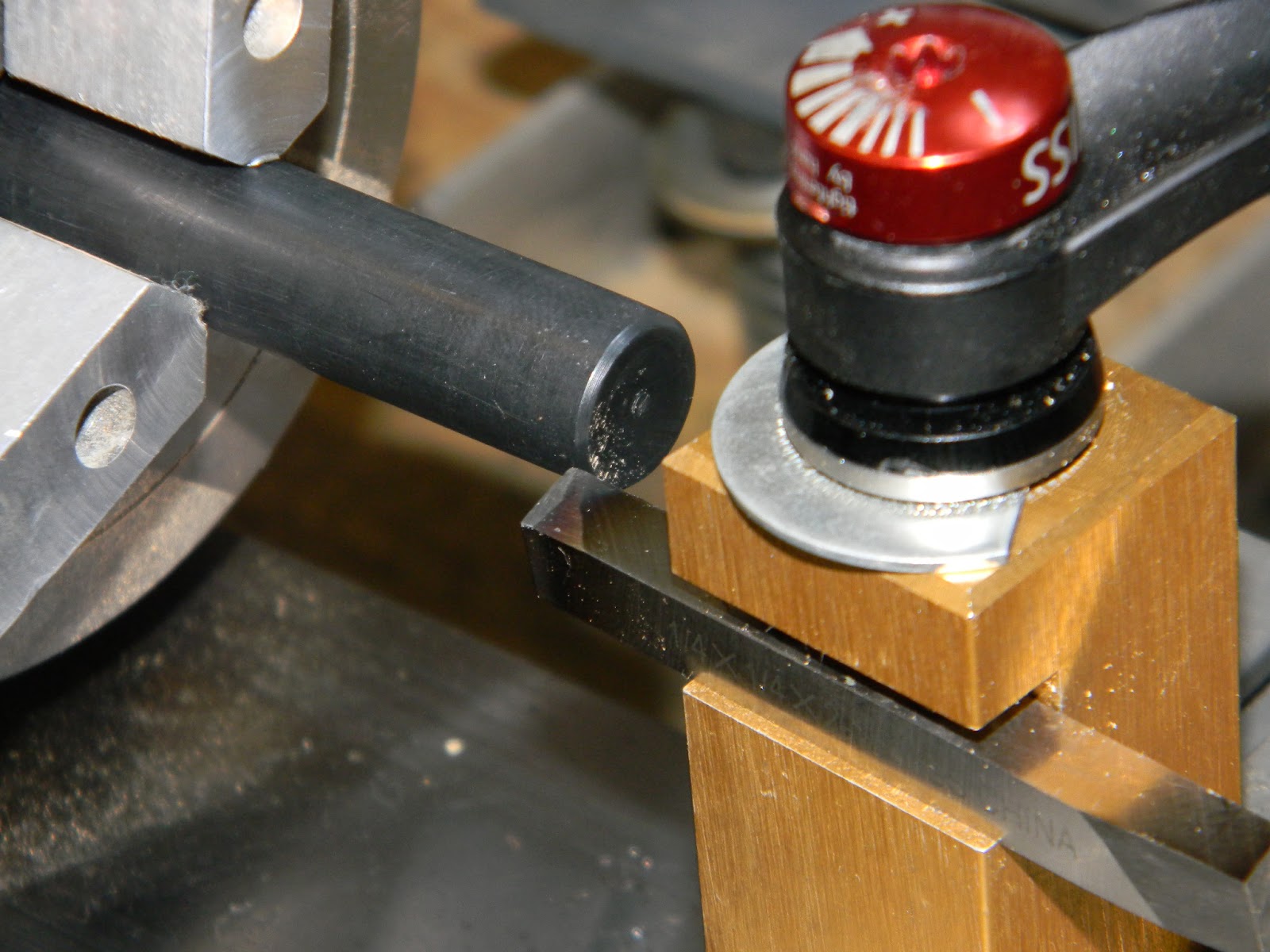
Kissed the end to remove the bevel and achieve a true flat.


 Spotted with a center drill.


Drilled about 3/4" deep with a 4.2mm drill bit.


 Followed by a M5 x 0.8mm tap.


Looked through the scrap box and found a stubby piece of 0.750" diam aluminum.


 Spotted


 Through drilled to clear a M5 bolt.


Turned down one end to 0.500"--the same diameter as the body of the  plunger.


Changed cutters to something with more of a point and cleaned up the inside corner.


Flipped the piece in the chuck and shortened the end with a parting tool.


Cleaned up the cut and beveled the outer edge.  Not shown:  Countersunk the hole for a flat head.


 Like so.


Pressed the stop pin back into place.


Sourced a spring at a local hardware store.  Just fits over the plunger.


 Bolted my endcap into place.


 Done.


 Drop in a pellet for sizing.


Spring opens the sizer for the next pellet.  Works like dy-no-mite.

More soon.