Saturday, February 11, 2012

Quick Update on the Sterling

Dissatisfied with the 570 fps the Sterling was making, I tore the gun down yet again.


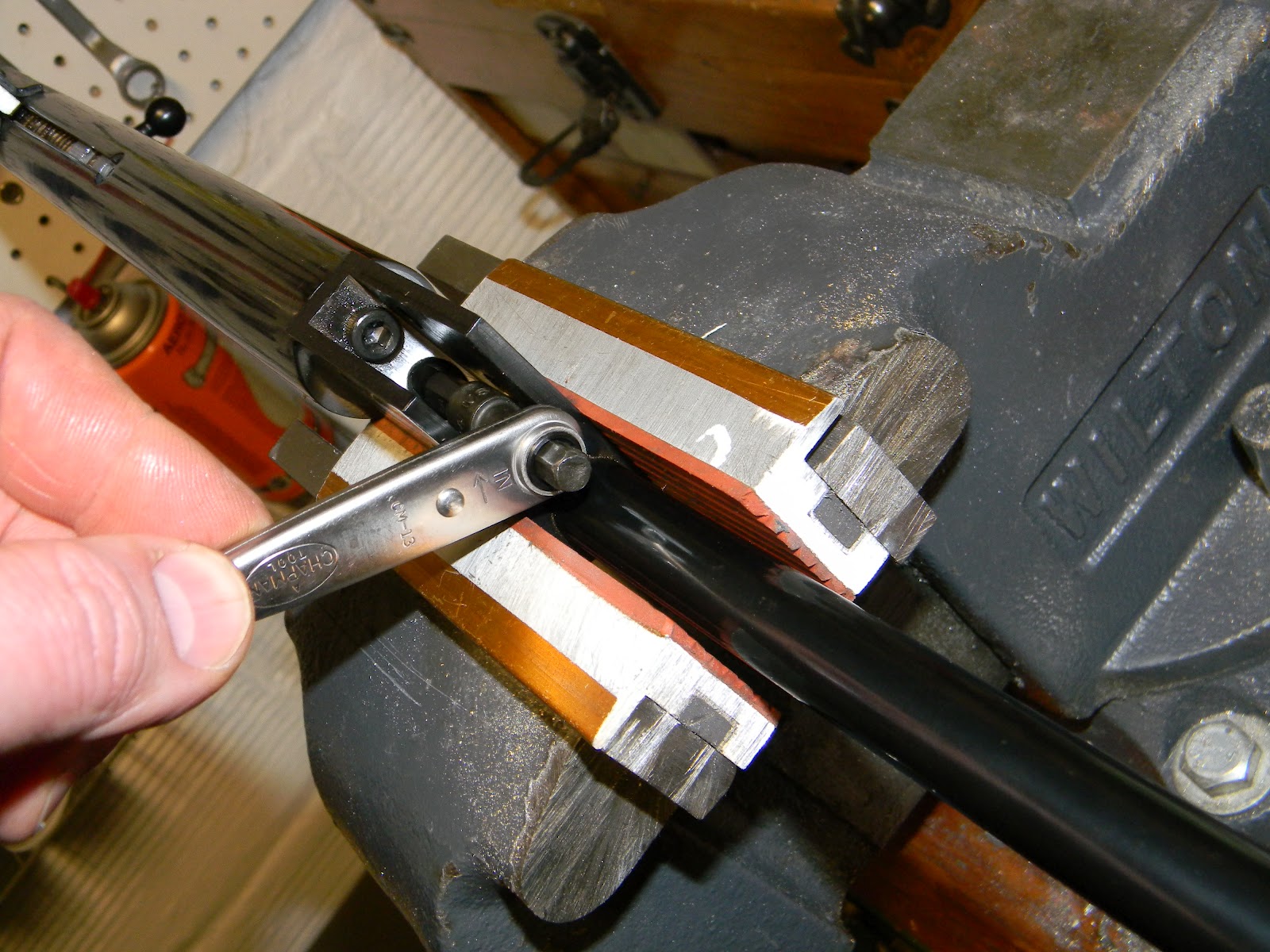
At least the compression tube can be disassmbled from the gun after removing only six bolts.


No damage to the face of the piston after over one hundred shots, so that's the good news.


No pics, but while I had the gun apart, I checked the bolt o-ring, but it was fine.  The next largest o-ring I had on hand didn't fit into the breech anyway.


Went through the box of mainsprings and found a similar spring that was about 0.750" longer.  Same OD, same ID.  I'll probably end up ordering a new higher quality spring from Air Rifle Headquarters.  The gun went back together and velocity increased to 600 fps for about twenty shots then dropped off to 580.   A drop of oil on the sides of the transfer port o-ring showed a leak like a breaching whale.  I'm getting bored with all the gun's idiosyncrasies, I stripped the compression tube again (six bolts!) and degreased the seats for the o-ring seal with acetone.  Glued the o-ring into place with a cyanoacrylate.  With the port sealed, velocity climbed to a high of 620 with the .20 cal H&N wadcutter. Another hundred shots and the velocity has stabilized at 615.

The washer in the compression tube is certainly disrupting the airflow, not to mention the square-shaped channel of the air transfer slot transitioning to round then making that ninety degree turn inside the bolt nose.  Way too much turbulence in the original design.  So, a replacement spring seems like potentially the most bang for the buck in terms of effort.  When (if?) I strip the gun again after sourcing a different spring, I'll also try a different piston seal.  I've got four more on order.

Probably something different next time around.  Need a break from this one for a while.

Thursday, February 9, 2012

Sterling in Purgatory

With the washer epoxied into the compression tube, I turned my attention to the trigger mechanism. 


Pushed out the forward pivot pin and pulled the sear out.


Counterbore for the spring.


Removed the trigger return spring.  It's exactly the same spring used on the sear.


To remove the trigger, the safety lever must be removed first.  A very small set of external snap ring pliers is required.


Snap ring removed, and the safety's pivot and lever are pulled out.  The sheet metal safety has small indentations for the detent ball.  The ball is visible in the center of the trigger pivot pin.


Trigger pivot pin is hollow to house a small spring and ball bearing.


Like so.


Trigger/sear orientation--cocked.  Note the overlap on surfaces.  These are the locations to polish and lube to smooth the pull.


Trigger pulled, microseconds before the rifle fires.


Sear in fired position.  Aside from polishing contact surfaces, I also cut a couple coils off the trigger return spring.


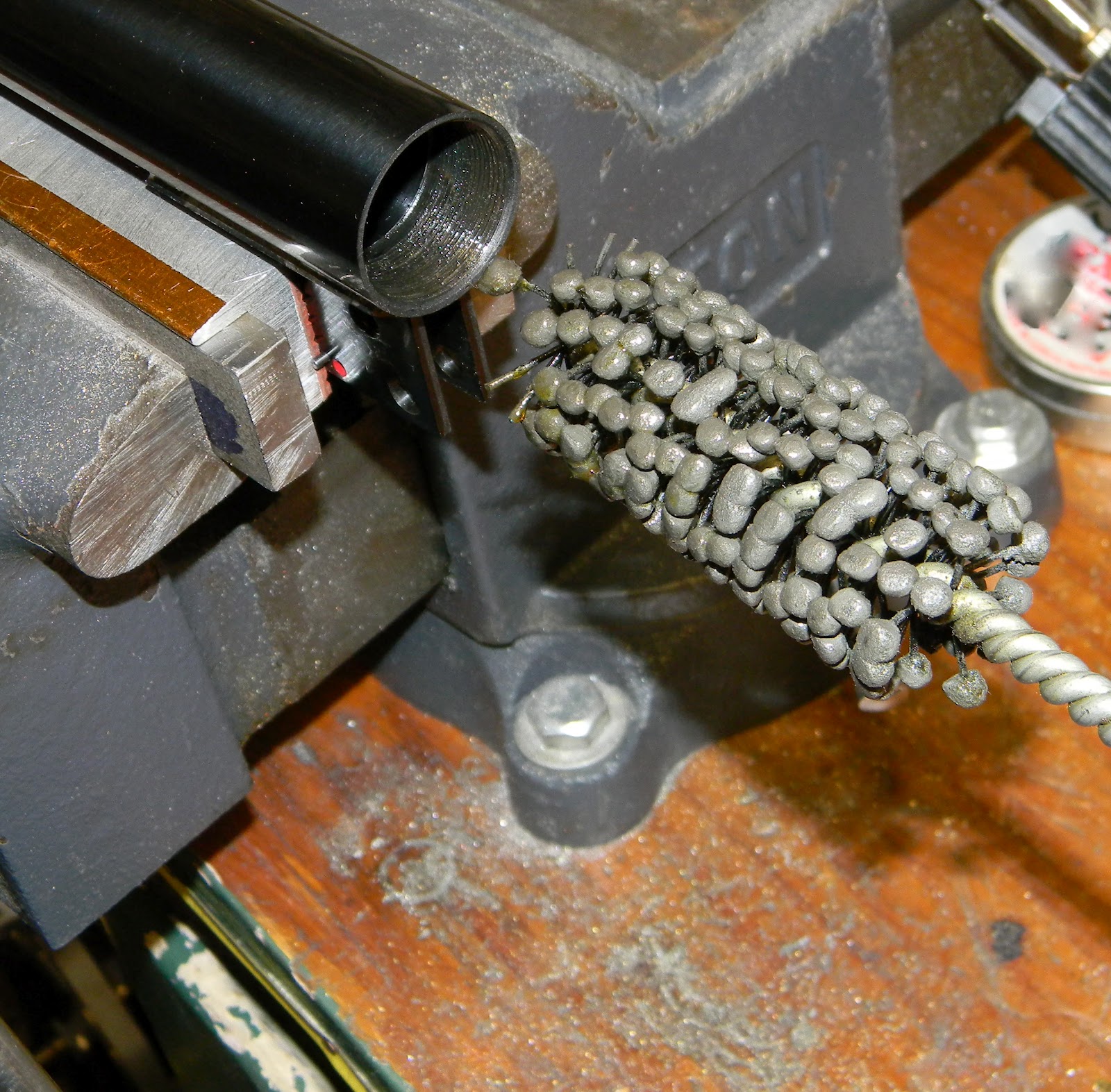
I fall into the "cross hatched" category for compression tubes.  A quick pass with a Brush Research Flex-Hone finished the inside of the tube beautifully.  Inexpensive at about $20.


Thin coat of moly on the piston and sides of the seal.


Mainspring got a coat of a viscous red synthetic grease.  Added a rotation washer to the base of the spring guide and reassembled the compression tube.  No pics, it was simply a reversal of the steps here.


While the bolt was still on the bench, it seemed like a good time to clean the barrel with J-B Non-Embedding Bore Cleaner.


Thin coat of silicone grease on the bolt o-ring...


and the transfer port o-ring.


Made sure the air passage in the bolt lined up when the handle is in the closed position.


Don't forget the setscrew to lock the handle in place.


The entire upper unit needs to be assembled before attaching the compression tube.


Dropped the action back into the stock, fired off about 40 shots then set up the chronograph.  With a .20 cal H&N wadcutter, the Sterling was doing a smooth and consistent 570 fps.  Great.  I was hoping for at least another hundred fps.  Dejectedly, I removed the compression tube again and pulled the mainspring and piston.  Removed all the tacky red grease and burnished the spring with copper anti-seize.  Next, I sized the piston seal down a few more thousandths for a looser fit in the compression tube.  Reassembled and sent more shots downrange to settle things in.  Across the chrony, the rifle was again still shooting that same 570 fps.  Some of the old reference material gave specs for the .20 cal as 640 fps, so 570 seems way too slow. But, looking around, I can't find any real world .20 cal Sterling numbers to compare against.

There is perhaps still some efficiency to be gained by revisiting the transfer port and sleeving it to decrease volume and dead space.  Possibly a tighter fitting o-ring on the bolt, or a different piston seal, too. 

I'm not a velocity chaser, but find this is a bit too slow given the sheer size of the rifle.  Maybe that's why it didn't fare well in the marketplace. 

I think I'll pull the modified piston and install the original, unaltered piston from the .22 cal rifle just to get some numbers from a box stock component.  Most likely, the only real gains will come from trying some different mainsprings.

We'll see what pans out.

Wednesday, February 1, 2012

"Fixing" the Sterling's Compression Tube

Been ruminating about the transfer port in the Sterling for a few days now. 


Those sharp-edges worried me.  It looked like it could/would eat the new piston seal within a few shots.  Thought about making an insert to fill in near the edge, but it seemed like difficult work considering it's so deep in the tube.


This 1" stainless steel washer should do the trick, but it's just a couple thousandths too large in diameter to fit into the compression tube. 


Mounted it on a mandrel and touched the edge with a mill file.  In about two seconds, it was sized.


The washer barely drops to the bottom of the tube.  (OK, it's technically the front of the tube, but you get the idea.) 


Washer is so thin so there won't be any appreciable change in compression stroke.


Used a good degreaser to thoroughly clean the inside of the tube. 


Cut a piece of aluminum tube to fit inside the length of the tube when the end cap is threaded down. 


The aluminum tube will push and hold the washer against the front of the tube as the J-B Weld epoxy sets up.  There's really not another way to secure the washer in place--at least, none that I could envision.


Not using the quick-set version.   Want the longer set-up time so I don't have to rush--as well as the higher strength. 


A plastic spacer wrapped near the end of a 3/16" steel rod allowed me to get down to the bottom of the tube without the epoxy covered end touching the inside wall.


Washer dropped into place and the rod and end cap installed.  I cleaned the excess epoxy from the transfer port and set it aside.  I'll look at this again in about twenty-four hours.  In the mean time, I'll clean the barrel and degrease the mainspring.  The stock could probably stand another coat of oil, too.

Reassembly should happen in another day or two.  Please check back.  I hope it all works.

Wednesday, January 25, 2012

Repairing the Damaged Sterling Piston

Slowly bringing the .20 caliber Sterling back to life.   Want to salvage the original damaged piston by reworking it to a different seal configuration.  I don't see much point in using the spare undamaged piston, as the seals aren't just difficult to obtain--they're impossible.  Couldn't warm up to that center-mounted rubber bumper, either.


Started by measuring the ID of the compression tube.  It's essentially a 1" bore.  Next, I went through my various seals.   The criteria:  Obviously fit to the tube was foremost, followed by availability, and to some extent, design.  I wanted the seal to have a relatively thick band near the edge for durability, as I'm concerned about the deep transfer port groove in the front of the Sterling's compression chamber.  Lastly, the seal had to be readily adaptable to the damaged piston.  Picked a spare seal I'd obtained from Crosman to fit my Remington Summit.  It's Crosman's part # B18-04-1A.  I think it was about $4.  (2/3/2012 correction:they cost $1.10) The piston seal requires a 60 degree (included) angle cone for attachment.  I'll get to that a bit later.


The head of the piston is brazed into the front end of the tube.  There's about half an inch of steel inside the tube, leaving lots of metal to work with.   Trued up the piston in a 4-jaw chuck on the Taig.  There's too much overhang here...


Added the steady rest, and started cutting off the damaged grooves.


At the last moment, I elected to leave a shoulder on the front of the piston.  Eventually, I turned this shoulder down to about 0.503" so a steel washer would press fit into place.  Thought this would provide some sort of protection for the actual front of the piston body.


With the shoulder finished, I spotted for a hole with a center drill.


Through-drilled with a #20 bit.


Tapped the hole M5 x 0.8mm.


Broke the edge with a countersink to finish the piston head.


Now, I need a 60 degree cone to mount that seal to the front of the piston.  Mounted the compound crosslide to the Taig set it to 30 degrees.  I cut this taper on a scrap of aluminum rod then realized I was going the wrong direction.  This would be too difficult to do additional machine work to the wide end of the cone...


Flipped the scrap in the jaws and readjusted the compound.  We'll call it -30 degrees.  Cut the cone in reverse.  Remember that the larger end is the front...


Here's where I eyeball everything,  I faced down the end until it just fit into the piston seal.


Through drilled to clear the M5 screw.


Countersunk to match the angle of the M5 flat head.  Cut until the head fit just below flush.


The rear of the seal has a 0.50" hole, so the rear of the cone must match that diameter.


A little layout fluid and some easy caliper work marked 0.500".  Cut just to the line with a parting tool.   


The piston, black steel washer, aluminum cone adapter, seal and bolt.


Couldn't have asked for a better fit.


Here it is above the spare stock piston.  Getting close, but I'm not quite ready to put the gun back together yet.

Check back soon.