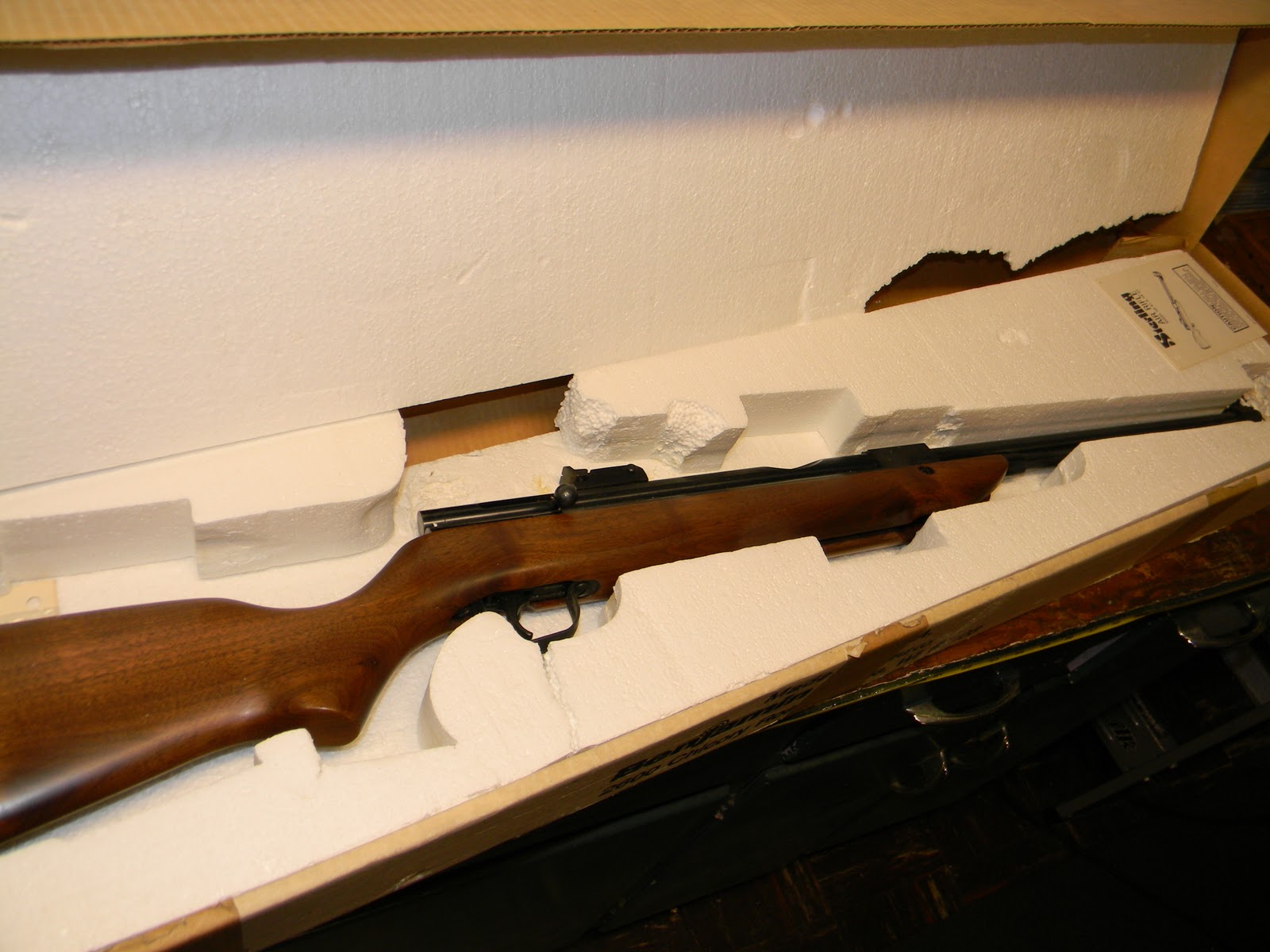
Wednesday, February 1, 2012

"Fixing" the Sterling's Compression Tube

Been ruminating about the transfer port in the Sterling for a few days now. 


Those sharp-edges worried me.  It looked like it could/would eat the new piston seal within a few shots.  Thought about making an insert to fill in near the edge, but it seemed like difficult work considering it's so deep in the tube.


This 1" stainless steel washer should do the trick, but it's just a couple thousandths too large in diameter to fit into the compression tube. 


Mounted it on a mandrel and touched the edge with a mill file.  In about two seconds, it was sized.


The washer barely drops to the bottom of the tube.  (OK, it's technically the front of the tube, but you get the idea.) 


Washer is so thin so there won't be any appreciable change in compression stroke.


Used a good degreaser to thoroughly clean the inside of the tube. 


Cut a piece of aluminum tube to fit inside the length of the tube when the end cap is threaded down. 


The aluminum tube will push and hold the washer against the front of the tube as the J-B Weld epoxy sets up.  There's really not another way to secure the washer in place--at least, none that I could envision.


Not using the quick-set version.   Want the longer set-up time so I don't have to rush--as well as the higher strength. 


A plastic spacer wrapped near the end of a 3/16" steel rod allowed me to get down to the bottom of the tube without the epoxy covered end touching the inside wall.


Washer dropped into place and the rod and end cap installed.  I cleaned the excess epoxy from the transfer port and set it aside.  I'll look at this again in about twenty-four hours.  In the mean time, I'll clean the barrel and degrease the mainspring.  The stock could probably stand another coat of oil, too.

Reassembly should happen in another day or two.  Please check back.  I hope it all works.

Wednesday, January 25, 2012

Repairing the Damaged Sterling Piston

Slowly bringing the .20 caliber Sterling back to life.   Want to salvage the original damaged piston by reworking it to a different seal configuration.  I don't see much point in using the spare undamaged piston, as the seals aren't just difficult to obtain--they're impossible.  Couldn't warm up to that center-mounted rubber bumper, either.


Started by measuring the ID of the compression tube.  It's essentially a 1" bore.  Next, I went through my various seals.   The criteria:  Obviously fit to the tube was foremost, followed by availability, and to some extent, design.  I wanted the seal to have a relatively thick band near the edge for durability, as I'm concerned about the deep transfer port groove in the front of the Sterling's compression chamber.  Lastly, the seal had to be readily adaptable to the damaged piston.  Picked a spare seal I'd obtained from Crosman to fit my Remington Summit.  It's Crosman's part # B18-04-1A.  I think it was about $4.  (2/3/2012 correction:they cost $1.10) The piston seal requires a 60 degree (included) angle cone for attachment.  I'll get to that a bit later.


The head of the piston is brazed into the front end of the tube.  There's about half an inch of steel inside the tube, leaving lots of metal to work with.   Trued up the piston in a 4-jaw chuck on the Taig.  There's too much overhang here...


Added the steady rest, and started cutting off the damaged grooves.


At the last moment, I elected to leave a shoulder on the front of the piston.  Eventually, I turned this shoulder down to about 0.503" so a steel washer would press fit into place.  Thought this would provide some sort of protection for the actual front of the piston body.


With the shoulder finished, I spotted for a hole with a center drill.


Through-drilled with a #20 bit.


Tapped the hole M5 x 0.8mm.


Broke the edge with a countersink to finish the piston head.


Now, I need a 60 degree cone to mount that seal to the front of the piston.  Mounted the compound crosslide to the Taig set it to 30 degrees.  I cut this taper on a scrap of aluminum rod then realized I was going the wrong direction.  This would be too difficult to do additional machine work to the wide end of the cone...


Flipped the scrap in the jaws and readjusted the compound.  We'll call it -30 degrees.  Cut the cone in reverse.  Remember that the larger end is the front...


Here's where I eyeball everything,  I faced down the end until it just fit into the piston seal.


Through drilled to clear the M5 screw.


Countersunk to match the angle of the M5 flat head.  Cut until the head fit just below flush.


The rear of the seal has a 0.50" hole, so the rear of the cone must match that diameter.


A little layout fluid and some easy caliper work marked 0.500".  Cut just to the line with a parting tool.   


The piston, black steel washer, aluminum cone adapter, seal and bolt.


Couldn't have asked for a better fit.


Here it is above the spare stock piston.  Getting close, but I'm not quite ready to put the gun back together yet.

Check back soon.

Saturday, January 21, 2012

Benjamin Sterling HR-81 Fallback Plans A and B

Not to be deterred by the defective compression tube on the Sterling, I went back up to Precision Airgun in Maple Heights, OH and showed the bad tube to Chuck.  He had a couple more Sterlings still in inventory, but not another .20 cal.  Neither of us wanted to cannibalize another gun just for the compression tube, though he seemed less concerned than me.  He dug around for a few minutes and found a cutaway/demo HR-81. ???!!!! Who has this kind of stuff lying around?


The tube looks intact. It was obviously made to show the unique bolt loading design.


Made from early (pre-Benjamin marked) components.  Maybe this was a way to use up some of the leftover British components.


Right side.  This is the bolt loading trough.  Note the line of brass at the brazed joint.


The cutaway on the left side shows a non-lead synthetic skirted pellet just forward of the air transfer port.


The bolt locked in the forward position has an o-ring to seal just behind the port.


Disassembled as in parts 1 and 2.  The trigger housing was cut--probably to show sear engagement and trigger function.  Certainly gave me a better understanding of their relationship.


After looking at it for a few minutes, I decided there just wasn't enough metal left in the housing to support the sear pivot pin.  There were also some small dimensional differences at the front of the tube that would've made retrofitting more difficult.  Reluctantly, I went back to see Chuck with the bad news.


He sent me off with another Sterling--this one in .22 cal--and told me to bring back whatever spare parts were left.  There's probably not a single thing wrong with the Sterling in .22 cal, I just want a .20 for some reason.  Certainly has something to do with losing two .20 cal rifles a few years ago--a Beeman R10 Deluxe and HW-77k.  Replacing my youth.


Took this one apart a bit differently.  This is a better method for the Sterling.  After removing the rear sight, I pulled the cocking lever then unbolted the intact compression tube from the breech.


My spring compressor is cross drilled for 3/4" dowel rods so the bed can be shortened to any length necessary.


The was much easier than working around barreled action with that protruding globe front sight.


OK.... There was almost a second of consideration about using the piston from this gun to simply replace the smashed one from the first.


Except the crash bumper is already deformed.  This is from sitting for years with spring pre-load.  No, I didn't shoot the gun beforehand.


Lemme see if I can get the camera to cooperate.


Remnants of the bumper in the air transfer port groove at the front of the compression chamber.  Which is nice.


Dug it out with a wooden matchstick.

So, the tube itself is a go, but the piston head design is a problem--at least in respect to sourcing replacement ring seals and perhaps also the design itself is flawed.  Then again, the bumper material is twenty years old...  Was the bumper found to be necessary or was it a design error?  Certainly can't presume to know more than the engineers who designed the gun in the first place.

In considering how to remake the piston, I don't know if a parachute seal will fare any better against that groove in the front of the tube.  Seems reasonable to start with the damaged piston and make it work with a readily available commercial seal.  Maybe something with a sturdy looking edge, certainly the groove itself is the issue.   Sorry, I'm just talking to myself here...

As always, more soon.